- Mar 1
A Nature Based Approach to Learning About Patterns
- Megan O'Malley
When I ask the children I work with what a pattern is, most of them say something like: Square, circle, square, circle. They aren't wrong. But somewhere along the way, patterns became something you complete on a worksheet. Something tidy, contained, and predictable. A skill to demonstrate rather than something to discover. And yet, step outside and patterns are everywhere! Not printed, not laminated, and not confined to a page. But full of life!
When children look closely at a snail shell, they see a spiral that grows as the snail grows. When they trace the veins of a leaf with their finger, they notice branching lines that look like the veins in their own bodies. When they look up at the stars at night, they see the same spotty pattern as the freckles on a friend's face. These are patterns, too. Outside, patterns are not something you finish and hand in. They are something you experience with your 5 senses. In the classroom, a pattern is often visual and two-dimensional. Outside, patterns can be seen, touched, heard, and even felt. The repeated crunch of footsteps on gravel. The continuous crash of the waves against the shore. The petals surrounding the centre of a flower.
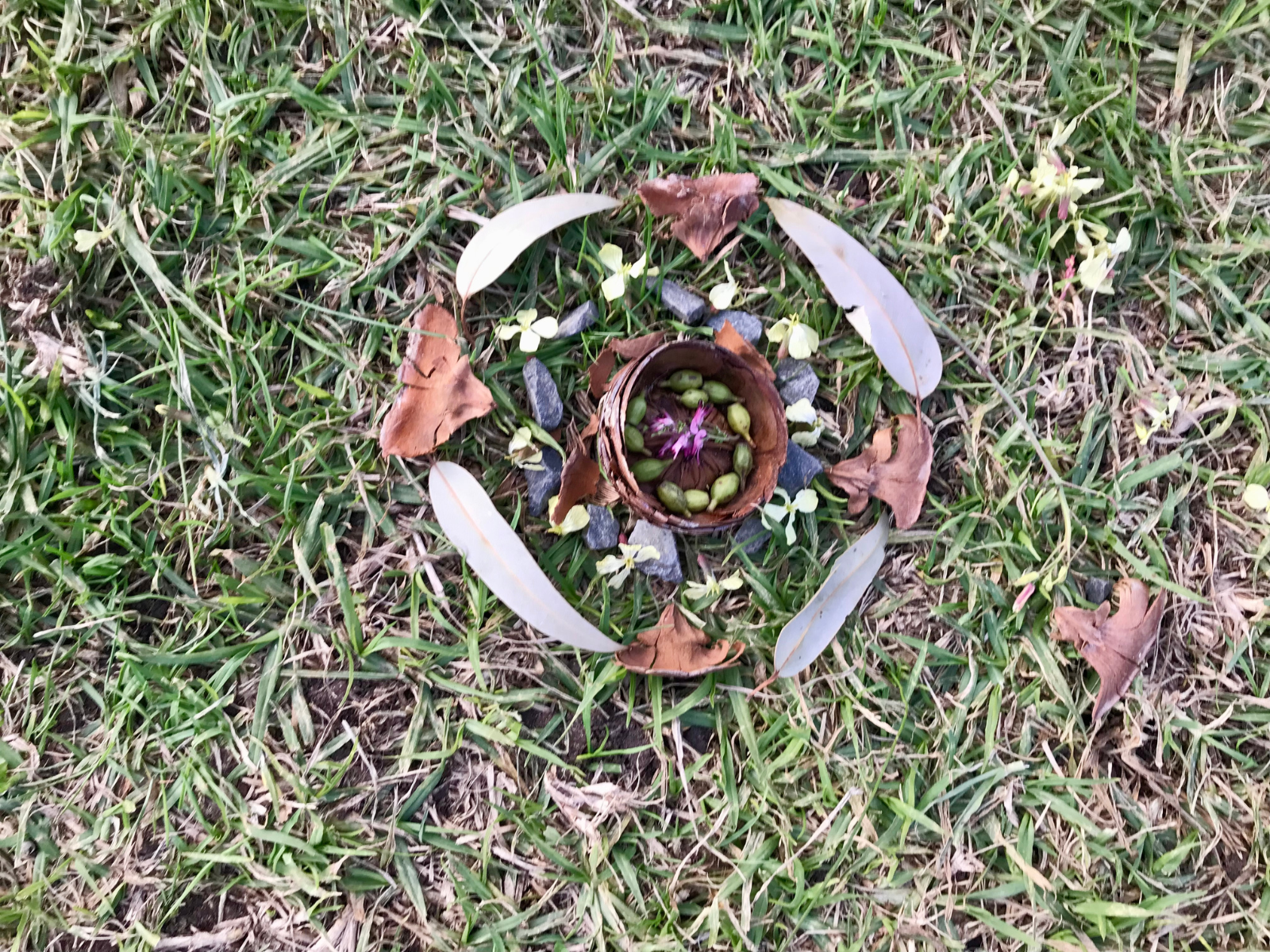
A nature mandala made by kids
When children explore patterns with all five senses, learning shifts. It becomes embodied. It becomes relational. It becomes something they are part of, not something they observe from a distance. This work is essential if we want to support the next generation to shape a better world. Because, before children can care for the world, they need to notice it. Before they can protect something, they need to feel connected to it. Noticing patterns outdoors trains the eye to slow down. It strengthens attention, builds curiosity and invites questions. Why does this repeat? Why are there patterns in nature? Can I find this pattern elsewhere in nature? These are scientific questions. Mathematical questions. Ecological questions. But they begin with something much simpler. Looking closely.
On the Meadow, I've just launched this month’s pack for kids aged 5-8, and it's jam-packed with activities and resources to help kids learn about patterns in nature. It invites children to step outside and search for spirals, symmetry, repetition and rhythm in the living world around them. To move like a pattern. To build their own from natural materials. To use their senses to notice what is out there. Once children learn to see patterns everywhere, they begin to understand that the world is layered, structured and full of quiet order. And that's kinda beautiful.
Subscribe to The Meadow today if you would like access to this pack.
Sign up to the Newsletter
Subscribe to be the first to receive news and updates!
I would like to acknowledge the Traditional Custodians of Country across this continent. I pay my deepest respects to Elders past and present. Aboriginal and Torres Strait Islander peoples are the original storytellers, educators, and change makers of Country. For generations, they have been on the frontlines in the fight for justice, truth, and sovereignty. Sovereignty has never been ceded. This always was, and always will be, Aboriginal land.