- Nov 2, 2025
"Too Sad for Words" - What Kids Really Think About Climate Change and Why We Need to Start Talking to Them About It
- Megan O'Malley
Last week, the Duty of Care Bill was voted down in Parliament. This was a bill that would have required politicians to consider how their decisions might harm the climate, and with it, the health and wellbeing of current and future generations.
Each year in Australia, around 1.4 million children and young people live through a climate-related disaster or extreme weather event. That’s roughly one in six children, and the number keeps climbing. Those in remote communities, lower-income households, and First Nations children are most at risk. The Intergovernmental Panel on Climate Change reports that children who were ten or younger in 2020 are expected to face almost four times as many extreme weather events if global warming reaches 1.5°C by 2100, and around five times as many if temperatures rise by 3°C. Some researchers believe we are already crossing that 1.5°C threshold in 2025.
So, introducing a bill that makes it mandatory for politicians to consider the climate and the future of our young people honestly feels like the bare minimum. Unfortunately, both Labor and Liberal politicians voted against the bill and it didn’t pass.
As I watched the news unfold, I couldn’t help but think of the Grade 6 kids I’d been working with just days earlier. I was curious to understand what they really think about climate change, what they know, what they feel, and what they want to know.
I wrote questions on butcher paper, told them there were no wrong answers, and handed them the pens. With their permission, I’m sharing what happened.
What they know
When I asked what they knew about climate change, they wrote:
“It’s bad.”
“It means the world is dying.”
“No one’s doing anything.”
“It is getting warmer.”
“The water is rising.”
“The icecaps are melting.”
“We did it.”
“People dying.”
“I don’t know if it will ever end.”
“CO2.”
“Cow farts.”
It’s fair to say they understand that climate change is bad, really bad, but most don’t grasp the details of what’s happening or what can be done about it.
How they feel
Next, I asked how they felt about climate change. Their answers were raw.
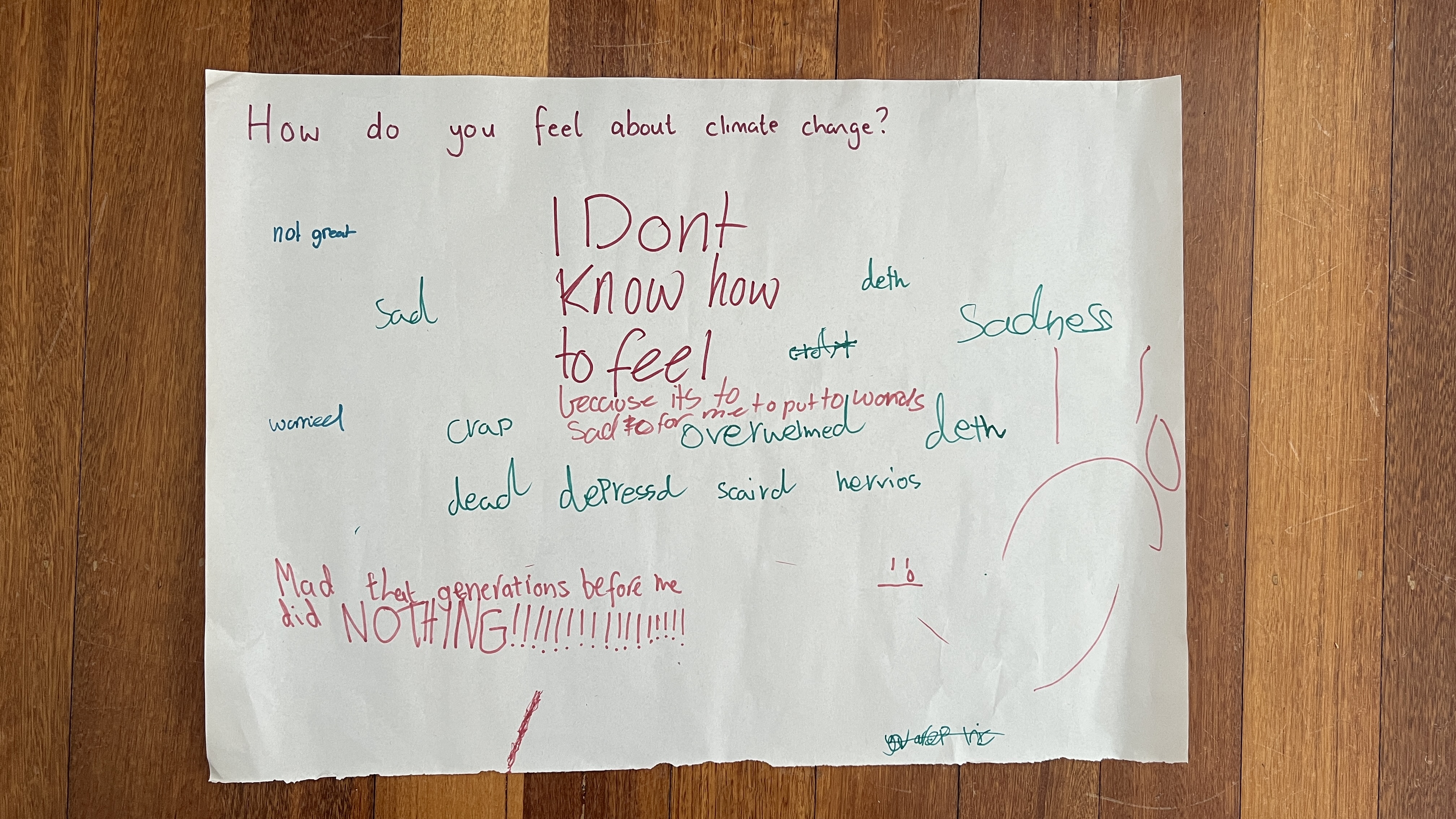
“I don’t know how to feel because it’s too sad for me to put to words.”
“I’m mad that generations before me did NOTHING!!!!!!!!!!”
“Death. Dead. Depressed. Scared. Overwhelmed. Nervous.”
It was bleak but not surprising.
In Australia, 89% of Australian kids aged 12 and 13 say climate change is probably or definitely something we should worry about and over two-thirds of young people aged 16-25 say climate concerns are having a negative impact on their mental health.
When I asked what impact climate change might have on them personally, the answers were short but heartbreaking:
“It will/is making me sad.”
“I will be hurt.”
“I will die soon.”
When I probed further, it was clear they weren't being dramatic. These were genuine feelings. While they didn't know exactly what was going to happen, the children truly believe that climate change will harm them and that their lives and futures are in danger.
What they think is being done
Next, I asked what they thought was being done to stop climate change, what solutions they knew of:
“Nothing at all sadly.”
“I think some people started using different materials in shops.”
“People are getting educated.”
“Not much at the moment.”
“Simple stuff, putting rubbish in the bin and picking up litter.”
For most of them, climate action looks like recycling or not littering. They know something is wrong, but aren't across what is being done to make it right.
What they think they can do
When I asked what they could do, their answers were a mix of hopeful and unsure:
“Encourage shops to use different materials for their packaging.”
“Prove people wrong.”
“Start taking action.”
“Write to MPs and whatnot.”
“Protest now.”
“Not listen to Trump.”
“Do your research.”
“Use common sense, unlike Donald Trump.”
They know Donald Trump is against climate action, that much is clear, but their understanding of their own power is murky.
What they want to know
Finally, I asked what questions they had about climate change. This is when the fear came pouring out.
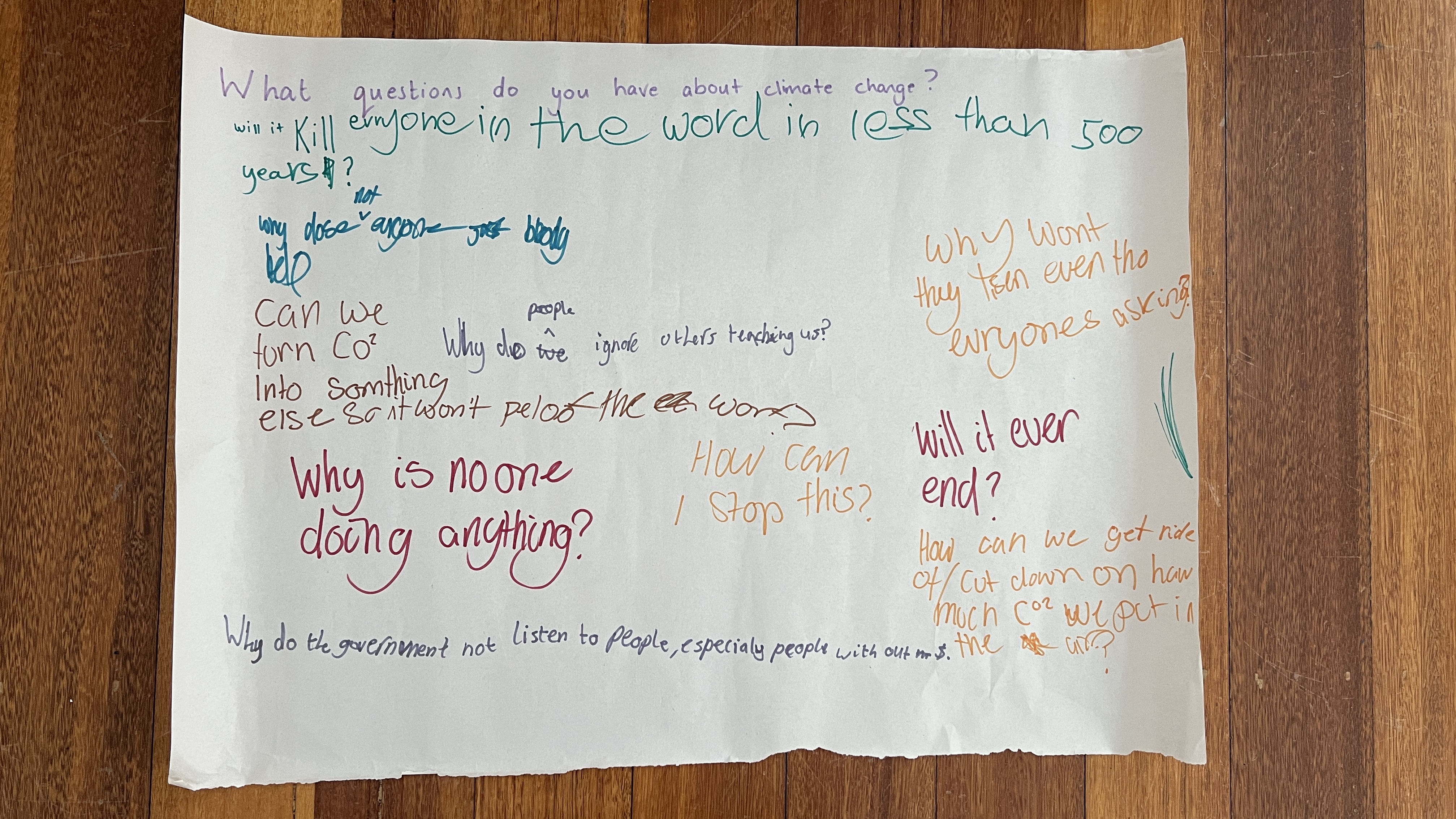
“Will it kill everyone in the world in less than 500 years?”
“Why doesn’t anyone bloody help?”
“Can we turn CO2 into something else so it won’t pollute the world? Why is no one doing anything?”
“Why do the government not listen to people, especially people without $?”
“How can I stop this?”
“Will it ever end?”
“Why won’t they listen even though everyone’s asking?”
“How can we get rid of/cut down on how much CO2 we put in the air?”
These kids are not ignorant. They’re not apathetic. They’re desperate for answers. They want to help, but they don’t know how. They’re frustrated that no one seems to be listening, least of all those with the power to act.
Climate change is the boogeyman
This activity helped something click for me.
For these kids, climate change is a kind of boogeyman. They know it’s big and scary. They’ve seen the floods, the fires, and the devastation on the news. But because no one is really talking to them about what it means for them, or what can be done, their imaginations are left to fill in the blanks. And their imaginations are running wild.
What parents, educators and carers can do
We need to get real with our kids. Because while climate change may be a difficult topic to broach, not talking about it isn’t an option. In fact, talking with children and helping them to take action on climate change boosts their hope, resilience, and sense of control.
Over the coming weeks, I’ll be exploring climate change with the kids I work with. We’ll talk about what’s already happening, what might happen where we live, and what it means for our communities. We’ll explore climate justice and how many communities that have contributed the least to climate change are facing its worst impacts.
We’ll also look at how the challenges of climate change can open up opportunities to create a fairer, more sustainable world. I’ll be giving the kids tools and knowledge to prepare for future disasters and helping them see where they can be part of the solutions, both small and big.
We need to prepare children for the future they face. Climate change is real, and it’s going to reshape the world in ways we can’t yet imagine. We need to help kids understand what’s happening, and give them the power to act. Because if our government won’t even pass a bill that acknowledges their right to a safe future, then it’s up to us, parents, carers, and educators, to decide what our own duty of care looks like.
And I believe it looks like this:
Equipping them with the truth.
Grounding them in hope.
And helping them adapt, act and prepare in real, tangible ways.
The what-ifs are already scaring them. But if we can give them the capacity to act and adapt, we're helping them to prepare for their future in real, meaningful and supportive ways.
For more ideas on how to support children to thrive in a changing world, download my free ebook.
Sign up to the Newsletter
Subscribe to be the first to receive news and updates!
I would like to acknowledge the Traditional Custodians of Country across this continent. I pay my deepest respects to Elders past and present. Aboriginal and Torres Strait Islander peoples are the original storytellers, educators, and change makers of Country. For generations, they have been on the frontlines in the fight for justice, truth, and sovereignty. Sovereignty has never been ceded. This always was, and always will be, Aboriginal land.